
Snack packaging plays a decisive role in protecting products from moisture, oxygen, and mechanical damage while maintaining shelf life and brand appearance. During production, storage, and transportation, snack packages often experience internal and external pressure changes. If seals or materials cannot withstand these stresses, leakage or sudden failure may occur. A packaging burst test provides a direct and reliable way to evaluate whether snack packaging can tolerate such pressure conditions.
By understanding the principles of the packaging burst test, relevant standards, and correct testing procedures, quality control professionals can identify weak seals early and improve packaging reliability before products reach the market.
What Is a Packaging Burst Test?
A packaging burst test evaluates the ability of a sealed package to withstand increasing internal pressure. During the test, air is introduced into the package until failure occurs or until a defined pressure level is maintained. The result reflects the maximum pressure the package can handle or its ability to survive a sustained load.
Для snack packaging, which often uses flexible pouches or bags with heat seals, this test provides clear insight into seal quality and overall package robustness.
Understanding ASTM F1140
ASTM F1140 is the primary standard governing burst and creep testing of packages. It defines multiple test approaches, including burst testing and creep testing, and explains how pressure differentials simulate real-world stresses such as sterilization, altitude changes, or transportation conditions.
By following ASTM F1140, manufacturers ensure that packaging burst test results remain consistent, comparable, and credible across different laboratories and production sites.
Role of a Package Leak Tester
A тестер герметичности упаковки designed for burst and creep testing integrates controlled pressurization, pressure monitoring, and data recording. Such systems help identify failure points, whether they occur at seals, materials, or interfaces, supporting both quality assurance and packaging development.
Why Snack Packaging Requires Burst and Creep Testing
Snack packaging often contains headspace gas and lightweight films. These features improve product freshness and reduce material usage, but they also increase sensitivity to pressure changes. A packaging burst test addresses several critical risks:
- Seal failure during transportation
- Gradual deformation under sustained pressure
- Inconsistent sealing performance on high-speed lines
By testing snack packaging under controlled pressure conditions, manufacturers gain confidence that packages will perform reliably throughout their life cycle.
Key Test Methods Explained Clearly
ASTM F1140 describes three main approaches used in a packaging burst test program.
Burst Test Method
In the burst test, the package is pressurized continuously until failure occurs. The system records the maximum pressure reached before burst, which indicates the package’s resistance to internal pressure.
This method works well for comparative studies, process validation, and quick quality checks during production.
Creep Test Method
In creep testing, the package is pressurized to a predefined level and held for a specified time. The result is typically pass or fail. This approach evaluates whether snack packaging can withstand sustained pressure without leaking or rupturing.
Creep to Failure Method
Creep to failure combines both concepts. The package is held at a higher pressure until failure occurs, and the time to failure is recorded. This method provides additional insight into long-term seal performance under constant stress.
Interpreting Test Results Correctly
ASTM F1140 emphasizes that burst and creep test results do not directly equal seal strength values measured by tensile methods. Instead, they reveal how the complete package behaves under pressure. Failure location, such as seal edge, corner, or material body, often provides more actionable insight than pressure values alone.
Consistent testing conditions remain essential when comparing results across different snack packaging designs or production batches.
Equipment Selection for Reliable Testing
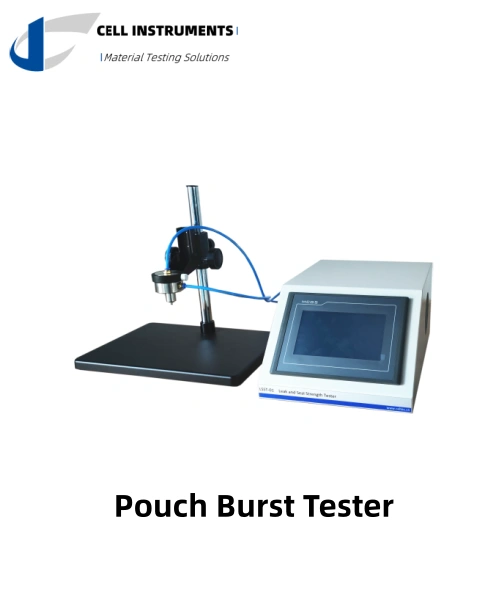
Accurate pressure control and stable measurement form the foundation of reliable burst and creep testing. The Cell Instruments LSST-01 Тестер разрыва подсумка supports burst and creep testing in line with ASTM F1140, offering controlled pressurization and precise pressure monitoring. Such equipment helps quality teams evaluate snack packaging performance efficiently while supporting both laboratory testing and production quality control.
Rather than focusing only on pass or fail, this type of system supports data-driven decisions for seal optimization and packaging design improvement.
Best Practices for Snack Packaging Quality Control
To maximize the value of packaging burst testing:
- Define acceptance limits based on product risk
- Combine burst and creep testing for comprehensive evaluation
- Use results to optimize sealing parameters
- Periodically verify equipment performance
These practices help integrate the packaging burst test into a robust quality management system.
Conclusion
Snack packaging must withstand pressure variations throughout its life cycle without compromising safety or freshness. A well-executed packaging burst test, guided by ASTM F1140, provides a practical and reliable way to evaluate seal integrity and package durability. By selecting appropriate test methods, controlling parameters, and using capable equipment, manufacturers can significantly reduce package failure risks and ensure consistent product quality.
 RU
RU  EN
EN  AR
AR  BG
BG  CS
CS  DA
DA  DE
DE  EL
EL  ES
ES  ET
ET  FI
FI  FR
FR  HU
HU  ID
ID  IT
IT  JA
JA  KO
KO  LT
LT  LV
LV  NB
NB  NL
NL  PL
PL  PT
PT  RO
RO  SK
SK  SL
SL  SV
SV  TR
TR  UK
UK